Desalination plays an essential role in securing water supplies worldwide. But what happens to the concentrated stream left behind? At Almar Water Solutions, we are exploring how brine valorization and mineral recovery can unlock new opportunities, turning a desalination by-product into a potential source of valuable resources.
Desalination is often described through its most visible outcome: turning seawater into a reliable source of fresh water. But for every desalination process, there is another stream that also needs to be considered: brine.
Brine is the concentrated saline stream that remains after part of the water has been separated from seawater or another saline source. It contains higher concentrations of salts and minerals than the original feedwater, as well as residual compounds associated with the treatment process.
Traditionally, brine has primarily been considered a stream to be safely managed and discharged. Today, however, advances in separation, concentration and recovery technologies are opening a different possibility: treating brine not only as a residual stream, but potentially as a source of valuable materials.
From brine management to brine valorization
In conventional seawater reverse osmosis plants, brine is typically returned to the marine environment through carefully designed discharge systems. Diffusers, appropriate outfall locations and environmental monitoring help control salinity increases and minimise potential impacts on marine ecosystems.
This remains an important and widely used approach. But as desalination capacity expands globally, interest is growing in technologies that can extract additional value from concentrated streams before final disposal.
Beyond desalination, naturally occurring saline waters, such as those found in geological formations, oilfields and salt flats, can also contain significant concentrations of specific minerals. With appropriate treatment technologies, these resources may offer further opportunities for mineral extraction and recovery.
This is where brine valorization comes in.
Instead of focusing exclusively on how to manage the concentrate, brine valorization explores whether some of its components can be separated and recovered for further use. Depending on the feedwater composition and treatment process, brines may contain minerals and compounds such as sodium chloride, magnesium, calcium, potassium and bromine, among others.
Recovering them could create additional value while reducing the volume or changing the characteristics of the stream requiring final management.
Mineral recovery: turning concentration into opportunity
The principle behind mineral recovery is straightforward, although its implementation can be technically complex: desalination already concentrates the salts and minerals naturally present in the source water. This concentrated stream can therefore become the starting point for additional separation and recovery processes.
Technologies under development or application include selective membranes, precipitation and crystallisation processes, ion exchange, adsorption and other advanced separation techniques.
The objective is not simply to recover as many minerals as possible. The real challenge is identifying which compounds can be recovered efficiently, at the required purity and at a cost that makes sense for a particular project.
This makes every brine valorization project highly site-specific. Brine composition, plant capacity, energy requirements, local mineral demand, logistics and the availability of potential end users can all determine whether recovery is technically and economically viable.
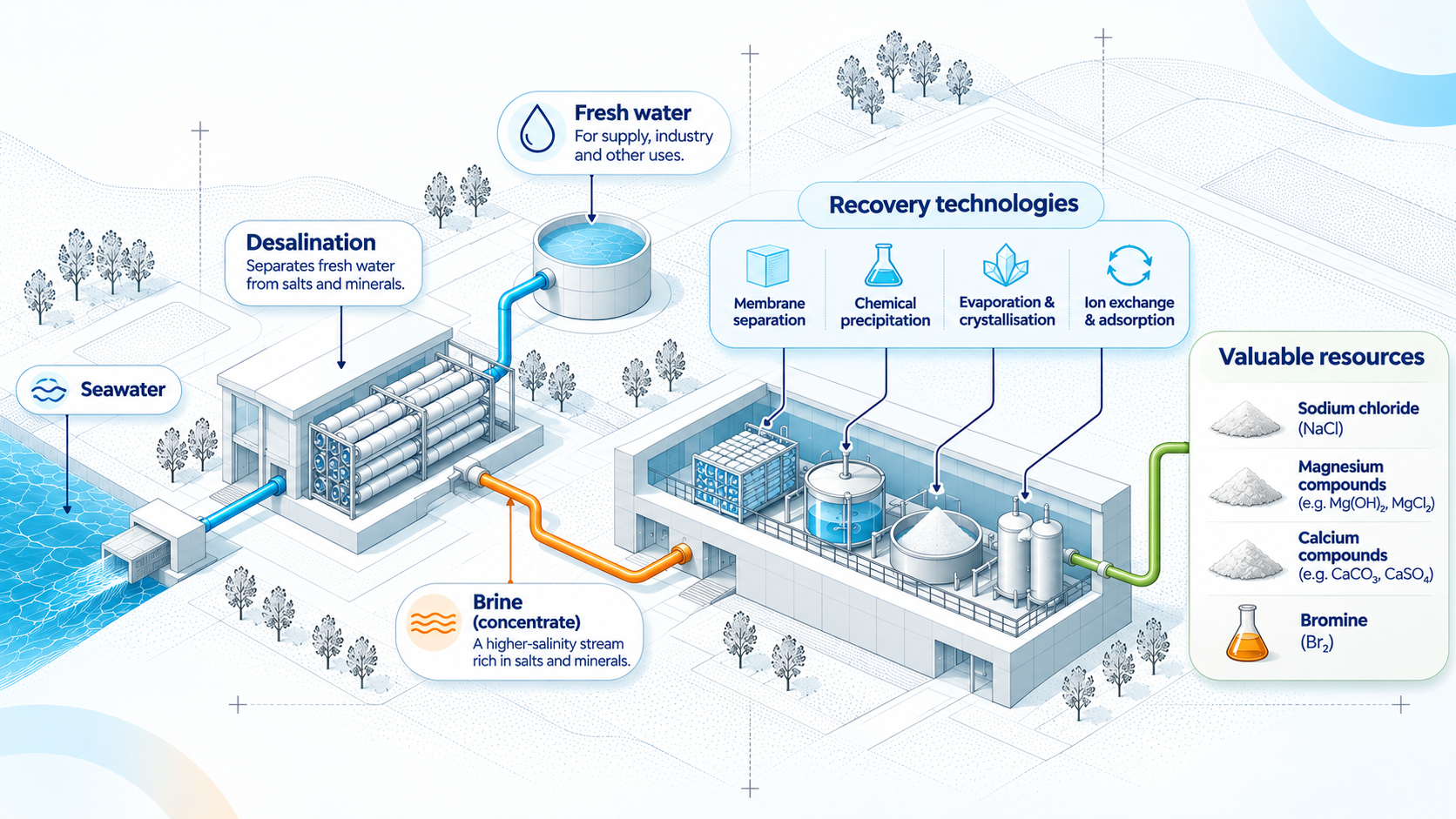
The technologies behind brine valorization
Recovering valuable materials from brine requires more than simply concentrating salts. Different technologies can be combined to selectively separate, concentrate and recover specific compounds, depending on the characteristics of the brine and the intended end products.
Some of the most relevant technologies include:
- Membrane-based separation: Processes such as nanofiltration and electrodialysis can selectively separate ions or increase their concentration, preparing the brine for subsequent recovery stages.
- Chemical precipitation: By adjusting operating conditions or adding specific reagents, dissolved minerals can be converted into solid compounds that can be separated and collected. This approach is particularly relevant for recovering calcium and magnesium compounds.
- Evaporation and crystallisation: Thermal or other concentration processes remove water from the brine, allowing salts to crystallise and be recovered. These technologies are also used in zero liquid discharge (ZLD) systems, although their energy requirements can be significant.
- Selective adsorption and ion exchange: Specialised materials can capture target ions from complex saline streams, offering potential opportunities for recovering specific minerals, including lithium, where concentrations and operating conditions justify their use.
In practice, the most effective solutions often combine several technologies into an integrated treatment process. Their selection depends on recovery efficiency, energy consumption, product purity and economic feasibility.
As these technologies continue to evolve, they are expanding the possibilities for recovering resources from desalination and industrial water treatment streams.
More value from the same water cycle
For desalination and industrial water projects, mineral recovery introduces a broader way of looking at water infrastructure.
A plant can potentially move beyond producing water to become part of a more integrated resource management system, where water, salts and minerals are considered together. This approach can support more circular industrial processes, create additional revenue streams and reduce the amount of concentrate requiring final management.
At Almar, we are exploring mineral recovery as part of our broader approach to environmental solutions. By combining our experience in desalination, water treatment and complex industrial projects with emerging recovery technologies, we aim to identify opportunities where brine can become a resource rather than simply the final stream of the desalination process.
The future of desalination will not only be about producing more water efficiently. It will also be about understanding how to make better use of everything that flows through the process.
Sometimes, what remains after producing water can be valuable too.