Water management is no longer just an operational matter. It is becoming a strategic business decision. As pressure on water resources, costs and regulatory requirements increases, more industrial companies are facing an important question: should they continue managing their own water infrastructure, or entrust this responsibility to a specialised partner?
Water is essential to many industrial processes. From mining and power generation to food production, chemicals and technology manufacturing, water availability and quality directly affect productivity and, in many cases, the viability of operations.
Yet securing a reliable water supply is becoming increasingly complex. Climate variability, energy costs, the need to optimise consumption and stricter environmental regulations are changing how businesses approach water management.
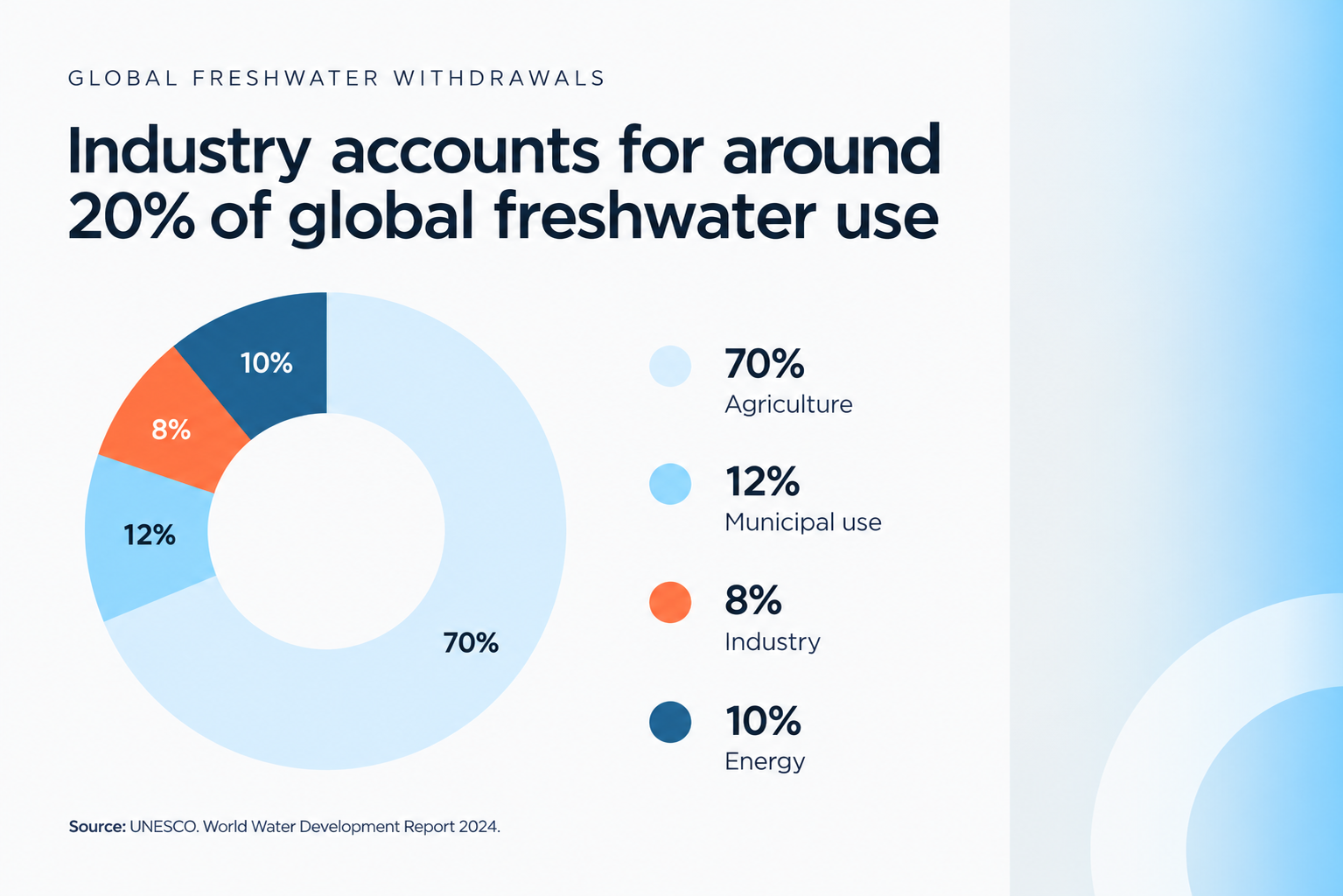
According to UNESCO’s United Nations World Water Development Report 2024, industry and energy together account for approximately 19% of global freshwater withdrawals. This figure highlights the importance of both sectors in global water resource management.
Against this backdrop, some industries are reconsidering a fundamental business decision: should they invest in and manage their own water infrastructure, or purchase water supply and treatment as a service?
What is Water as a Service and how does it work?
Traditionally, many industrial companies have developed their own water supply, treatment and wastewater infrastructure. This involves capital investment, employing specialised personnel, maintaining equipment and taking responsibility for operational risks.
Water as a Service (WaaS) offers an alternative. Depending on the client’s needs and the scope of the agreement, a specialised company can take responsibility for designing, financing, building, operating and maintaining water infrastructure.
Rather than investing directly in all the assets, the industrial customer purchases a service with agreed standards for water quality, availability, capacity and performance.
These arrangements can take different contractual and financial forms, ranging from operation and maintenance agreements to privately financed models involving long-term, integrated water management.
The key difference is not necessarily who owns the infrastructure, but how responsibilities and risks are allocated, and how service delivery is linked to measurable performance.
For example, an industrial facility requiring a specific volume and quality of water can contract its supply under predefined conditions. The specialist provider manages the activities covered by the agreement, allowing the industrial company to focus its resources on its core production processes.
Why are some industries adopting this model?
The growing interest in Water as a Service is driven by a combination of financial, operational and environmental factors that are becoming increasingly important in industrial decision-making.
Optimising capital and improving financial predictability
Water treatment, desalination and reuse infrastructure can require substantial investment. Under certain WaaS arrangements, companies can reduce their upfront capital expenditure and replace part of their direct investment with service-based payments.
This can free up financial resources for other priorities, such as expanding production capacity, modernising facilities or developing new projects.
Contracts can also bring different operating costs together under an agreed payment structure, making long-term financial planning easier.
However, the benefits depend on the contractual terms, price adjustment mechanisms and accounting treatment of each arrangement.
Technical expertise and risk management
Industrial water management requires expertise across several disciplines, including process engineering, treatment technologies, automation, maintenance, quality control and environmental compliance.
Outsourcing selected activities allows companies to access these capabilities without having to develop all of them in-house.
It can also support a more effective allocation of technical and operational risks. Contracts may establish availability commitments, water quality indicators, maintenance responsibilities and procedures for responding to incidents.
For industries where an interruption to the water supply could bring production to a halt, these commitments are particularly important.
Operational efficiency and adapting to new requirements
A facility’s water requirements can change over time as production expands, processes evolve or new environmental obligations come into force.
A well-structured service model can include mechanisms to adjust treatment capacity, improve equipment performance and introduce new technologies.
Monitoring, preventive maintenance and energy optimisation can all help improve efficiency throughout the operational life of the infrastructure.
The objective is not simply to keep the infrastructure running, but to ensure that its performance continues to meet the actual needs of the industrial operation.
Water reuse is creating new investment opportunities
Water reuse is one of the areas with the greatest potential for growth in industrial water management.
Many industrial processes do not require drinking-quality water. Applications such as cooling, industrial cleaning and certain auxiliary operations can use reclaimed water, provided it meets the relevant technical and health standards.
This can reduce demand for conventional water resources and turn treated wastewater into an alternative source of supply.
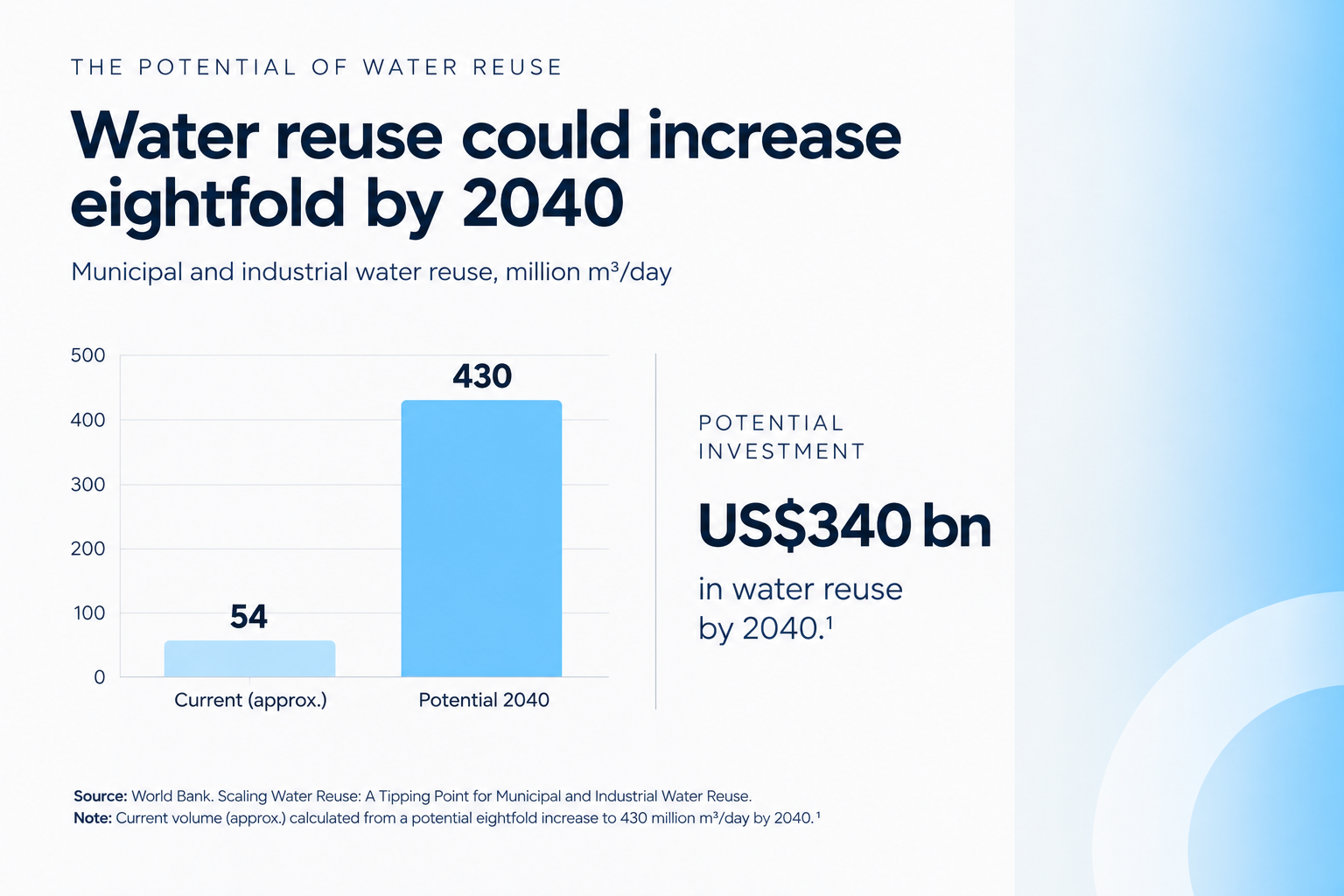
In its report Scaling Water Reuse: A Tipping Point for Municipal and Industrial Water Reuse, the World Bank estimates that municipal and industrial water reuse could increase eightfold by 2040, reaching approximately 430 million cubic metres per day.
The report also identifies potential investment of up to US$340 billion associated with this expansion.
These figures highlight a significant market opportunity, although realising this potential will depend on project economics, regulatory frameworks, available financing and the acceptance of water reuse solutions.
In industrial settings, the opportunity is particularly attractive where wastewater sources are located close to where the water will be used, as is often the case in industrial complexes and parks.
However, developing these projects requires more than selecting the right treatment technology. Water quality, demand, energy costs, distribution infrastructure and financial viability must also be assessed.
Water as a Service models can help structure these investments through contracts that link financing, operations and water supply to long-term performance commitments.
One solution does not fit every industry
Although Water as a Service offers opportunities, industrial sectors have different water requirements and do not necessarily benefit from the same management arrangements.
In mining, for example, the main challenge may be securing large volumes of water in water-scarce regions while treating complex wastewater streams.
In food and beverage production, water quality and process safety are critical. Chemical and petrochemical facilities may require specialised treatment technologies to manage complex wastewater and meet strict discharge limits.
In sectors such as power generation, data centres and semiconductor manufacturing, reliable water supply and precise quality control are essential to maintaining operations.
These differences mean that any industrial water management solution must begin with a detailed assessment of the facility’s requirements.
The volume and quality of water needed, available sources, existing infrastructure, regulatory conditions and investment horizon all influence the choice of technology and contractual model.
In some cases, fully outsourcing water management may offer clear advantages. In others, retaining certain assets in-house while contracting specialist services for specific activities may be more appropriate.
Ultimately, the value of Water as a Service lies not in applying a standard model, but in developing solutions tailored to the technical, operational and financial needs of each industry.
From water supplier to strategic industrial partner
The shift towards service-based models is also changing the role of specialist water companies.
Expertise in treatment technologies remains essential, but it is no longer enough on its own. Understanding industrial processes, structuring investments, managing assets and responding to changing customer needs are becoming equally important.
At Almar Water Solutions, this approach is reflected in a value proposition built around tailored solutions and long-term partnerships, combining technical, financial and operational capabilities to address each customer’s water challenges.
Its experience in developing, financing, constructing, operating and managing water infrastructure, together with its industrial water and environmental solutions activities, enables different services and technologies to be integrated into a management strategy tailored to each project.
From water supply and treatment to reuse, wastewater management and asset optimisation, the focus is on developing solutions that help improve industrial efficiency and competitiveness.
Is the value of water changing for industry?
The growing interest in models such as Water as a Service reflects a broader shift in how industrial companies make decisions about their resources and infrastructure.
Asset ownership is no longer necessarily the only consideration when evaluating an investment. Availability, performance, flexibility and the ability to adapt over time are becoming increasingly important.
As pressure on water resources grows, companies need to assess which management model best meets their operational requirements, risk profile and financial priorities.
This raises a question that goes beyond technology: If water is essential to industrial business continuity, is owning the infrastructure more important than ensuring its long-term performance?