The development of green hydrogen is creating new opportunities to bring water and energy management together under a shared sustainability strategy. At Almar Water Solutions, we are expanding into new energy and environmental solutions, building on our experience across the entire water cycle to develop projects that combine innovation, efficiency and responsible resource management.
The development of green hydrogen is creating new opportunities to bring water and energy management together under a shared sustainability strategy. At Almar Water Solutions, we are expanding into new energy and environmental solutions, building on our experience across the entire water cycle to develop projects that combine innovation, efficiency and responsible resource management.
Green hydrogen is emerging as an important solution for decarbonising industries where direct electrification remains particularly challenging. Its potential applications range from fertiliser and synthetic fuel production to energy-intensive industrial processes.
However, producing green hydrogen depends on two essential resources: renewable electricity and water.
While energy availability and cost tend to dominate discussions about the viability of hydrogen projects, water is an equally important consideration that needs to be addressed from the earliest planning stages.
The question is not simply how much water green hydrogen requires, but where that water comes from, what quality is needed, how it should be treated and how a sustainable supply can be secured over the long term.
How much water does green hydrogen really need?
Green hydrogen is produced through electrolysis, a process that uses renewable electricity to split water molecules into hydrogen and oxygen.
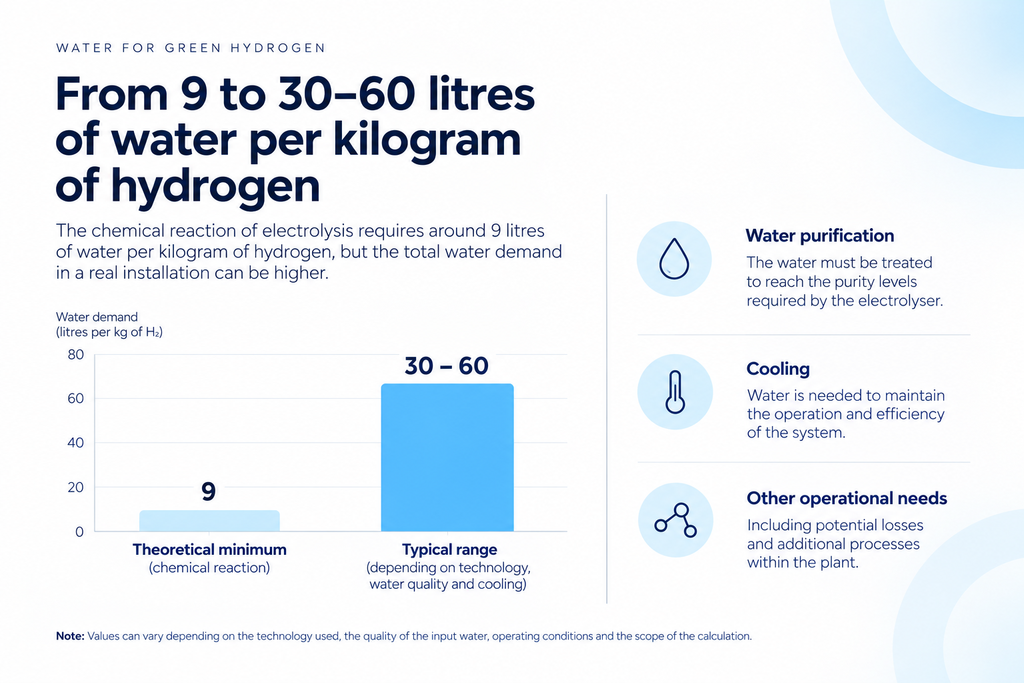
From a chemical perspective, producing one kilogram of hydrogen requires approximately 9 litres of water. However, this figure represents only the theoretical minimum needed for the reaction itself.
In an industrial facility, water is also needed for purification, cooling and other auxiliary processes. Depending on the technology, operating conditions and the quality of the incoming water, total demand can be considerably higher.
This is why water consumption cannot be assessed solely on the basis of the chemical reaction. The entire facility and the characteristics of its location must be taken into account.
The impact also needs to be assessed at a local level. According to the International Renewable Energy Agency (IRENA), although hydrogen production may account for a relatively small share of global water demand, its development could place significant pressure on available resources in certain regions.
Not all water is suitable for hydrogen production
Water availability matters, but so does water quality.
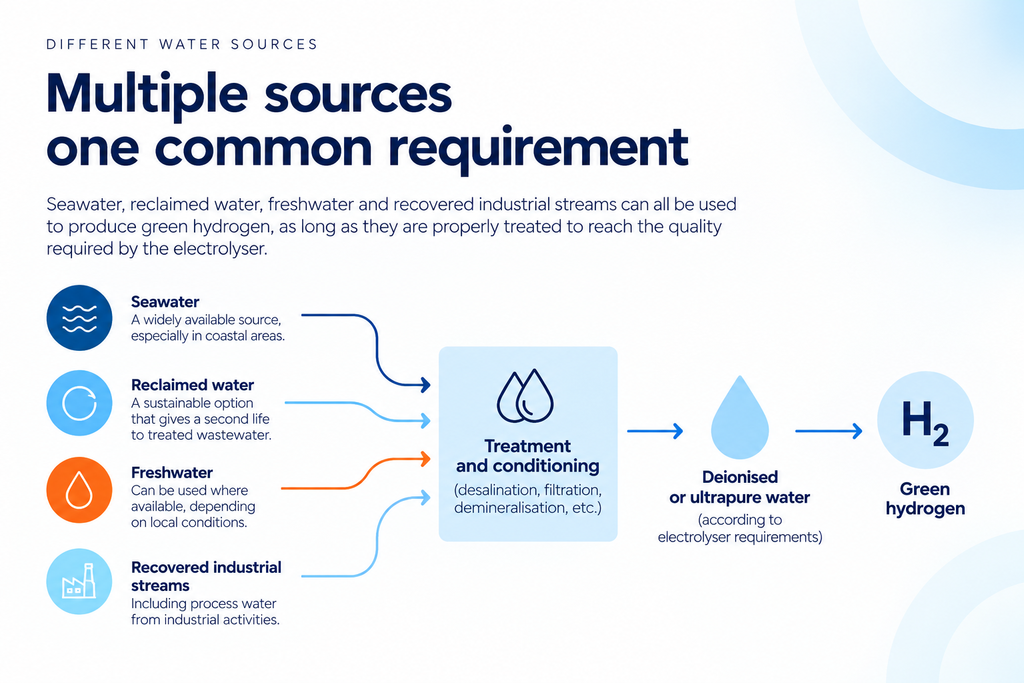
Electrolysers require high-purity water, generally deionised or ultrapure, to operate efficiently and protect their components. Salts, minerals and other contaminants can affect equipment performance and shorten its service life.
This means that, regardless of its source, water must undergo appropriate treatment before it can be used in electrolysis.
Existing technologies make it possible to use a range of water sources, including:
- Seawater, through desalination followed by further treatment and conditioning.
- Reclaimed water, sourced from wastewater treatment plants and subjected to additional treatment.
- Freshwater, where availability and environmental conditions allow for responsible use.
- Recovered industrial water streams, which can be treated and reused within certain industrial facilities.
Each option involves different technical, energy and economic requirements. The most suitable choice will depend on the characteristics of the project, local water availability and the potential impact on other users and ecosystems.
Desalination and water reuse to reduce pressure on resources
Some of the regions with the greatest potential for green hydrogen production, thanks to their abundant solar and wind resources, also face significant water constraints.
This is the case in parts of the Middle East, North Africa, Chile and Australia.
Choosing the right location can be one of the most important factors in the success of a green hydrogen project. Beyond access to renewable energy, developers must consider the availability of reliable water sources, water quality and long-term supply conditions. In water-stressed regions, these factors can ultimately determine where a facility is built, directly influencing its technical, economic and environmental viability.
Considering water availability during site selection helps anticipate risks, optimise investment and strengthen long-term supply security. In this context, proximity to alternative water sources, such as seawater or treated wastewater, can offer a strategic advantage when developing new projects, without necessarily increasing pressure on conventional freshwater resources.
Desalination makes it possible to convert seawater into a resource suitable for further treatment and conditioning. Meanwhile, wastewater reuse allows water already circulating within the water cycle to be recovered and put to productive use, helping to reduce withdrawals from natural sources.
Both solutions illustrate a fundamental principle: the sustainability of a hydrogen project depends not only on the use of renewable electricity, but also on how the other resources required for production are sourced and managed.
Integrating water from the outset to improve efficiency and competitiveness
As green hydrogen projects grow in scale, water management becomes more than a technical consideration. It becomes a strategic decision.
Securing a reliable water supply throughout a facility’s operational life requires an assessment of future water availability, treatment requirements, energy costs, effluent management and potential environmental and regulatory risks.
It also means exploring opportunities to recover water, optimise cooling systems or share infrastructure with other industrial activities.
These decisions have a direct impact on capital investment, operating costs and plant reliability.
For this reason, water infrastructure should be planned alongside energy infrastructure and production processes, rather than treated as an auxiliary system to be added once the project has been defined.
This integrated approach helps identify more efficient solutions, reduce risks and improve long-term competitiveness.
Water and energy are becoming increasingly interconnected
Green hydrogen is a clear example of the water–energy nexus: the interdependence between water and energy resources.
Energy is needed to abstract, transport, treat, desalinate and reuse water. At the same time, water plays an essential role in numerous energy production and conversion processes.
This relationship calls for a broader approach to industrial infrastructure.
At Almar Water Solutions, we recognise that the challenges surrounding water, energy and sustainability are increasingly interconnected. Alongside our activities across the entire water cycle, we are therefore developing complementary business areas, including green hydrogen and other environmental solutions focused on decarbonisation and the circular economy.
Our experience in desalination, water treatment, reuse and water infrastructure management provides valuable capabilities to address the water requirements of these emerging industrial activities, from supply planning and treatment to long-term management.
Our aim is to develop integrated solutions that make better use of resources, reduce environmental impacts and support a more efficient and sustainable industrial sector.
Green hydrogen needs water, but its development does not have to place additional pressure on conventional freshwater resources.
What matters is how each project is planned and the decisions made from the outset about how water is sourced, treated and managed.