Australia has spent decades learning to manage one of its most unpredictable resources: water. Prolonged drought, declining rainfall in some regions, urban growth and water-intensive industries have created pressures that are now familiar across the world.
Australia’s experience is not simply a story of scarcity. It shows how countries can improve water security through a broader supply mix, investment in infrastructure, water reuse, demand management and long-term planning.
As climate patterns become less stable and competition for water grows, Australia’s approach offers useful lessons for other regions.
Living with water variability
Water availability in Australia varies sharply by region and season. Some areas face heavy rainfall and floods. Others endure recurring drought, high evaporation and growing pressure on freshwater supplies.
The Millennium Drought, which affected much of southern Australia from the late 1990s to 2009, changed the country’s approach to water management. Falling reservoir levels and severe restrictions exposed the weakness of systems that relied heavily on rainfall.
The response went beyond temporary conservation. Major cities invested in desalination, expanded water recycling and adopted new ways to manage demand and plan water supplies.
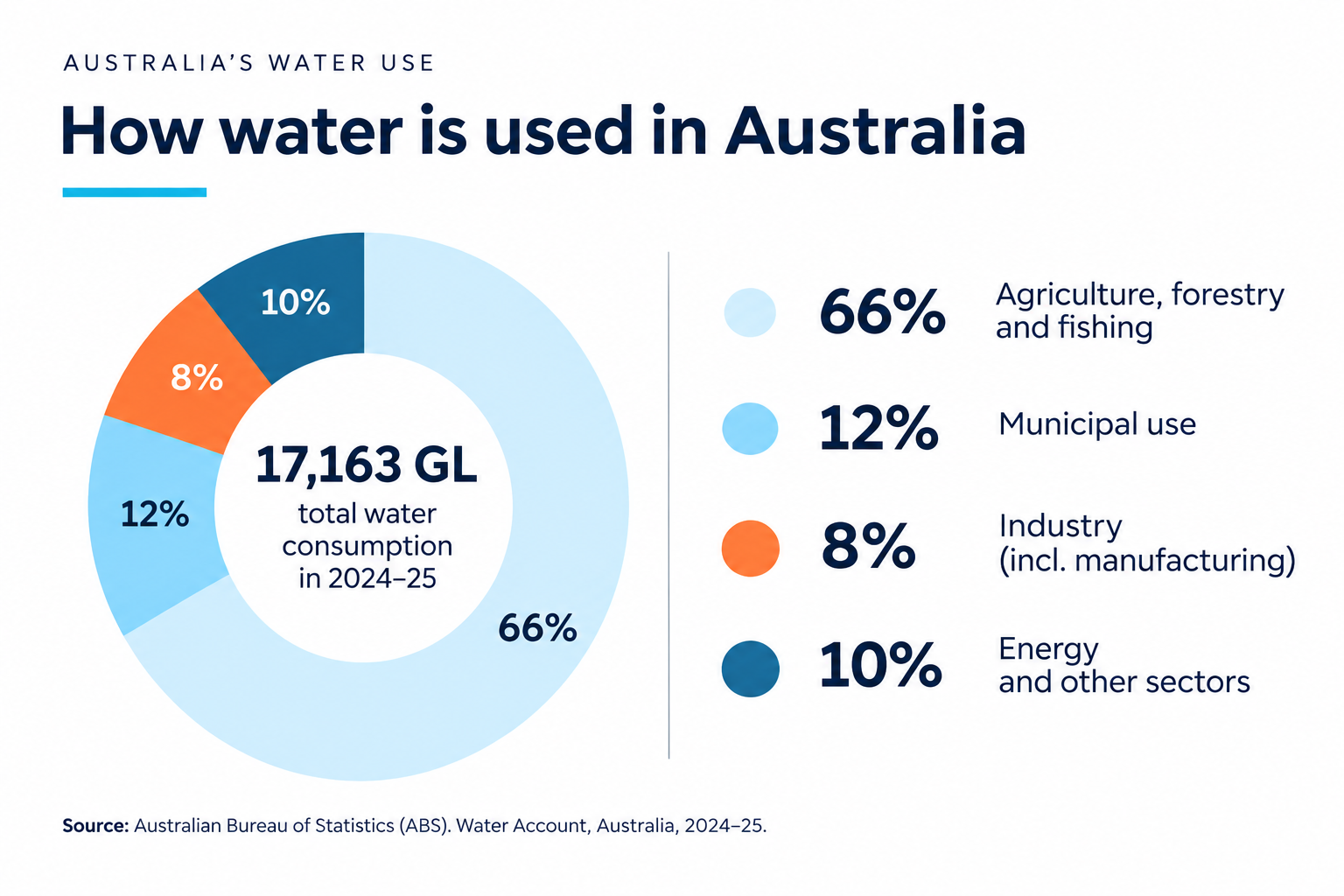
According to the Australian Bureau of Statistics (ABS), national water consumption reached 17,163 gigalitres (GL) in 2024–25. Rainfall fell by 4.2% from the previous year, while accessible water in major dams declined by 9.5%.
The figures make one point clear: water security depends not only on how much water is available, but also on how quickly and effectively systems can adapt.
Diversifying water supply: the Australian approach
One of Australia’s clearest lessons is the need for a broader mix of water sources.
Australian cities once relied mainly on reservoirs and surface water. Prolonged droughts exposed the risk of depending on sources tied closely to rainfall.
Several large urban systems now combine surface water, groundwater, seawater desalination, recycled water and measures to manage demand.
Perth is a useful example. The city, in Western Australia, has faced a long-term decline in rainfall and reservoir inflows. It has therefore reshaped its supply system over time. Desalination and groundwater now meet a large share of demand and reduce its reliance on rainfall.
National figures reflect the same shift. In 2024–25, desalinated water supplied by Australian utilities rose by 16% to 199 GL. Recycled water increased by 5.5% to 323 GL.
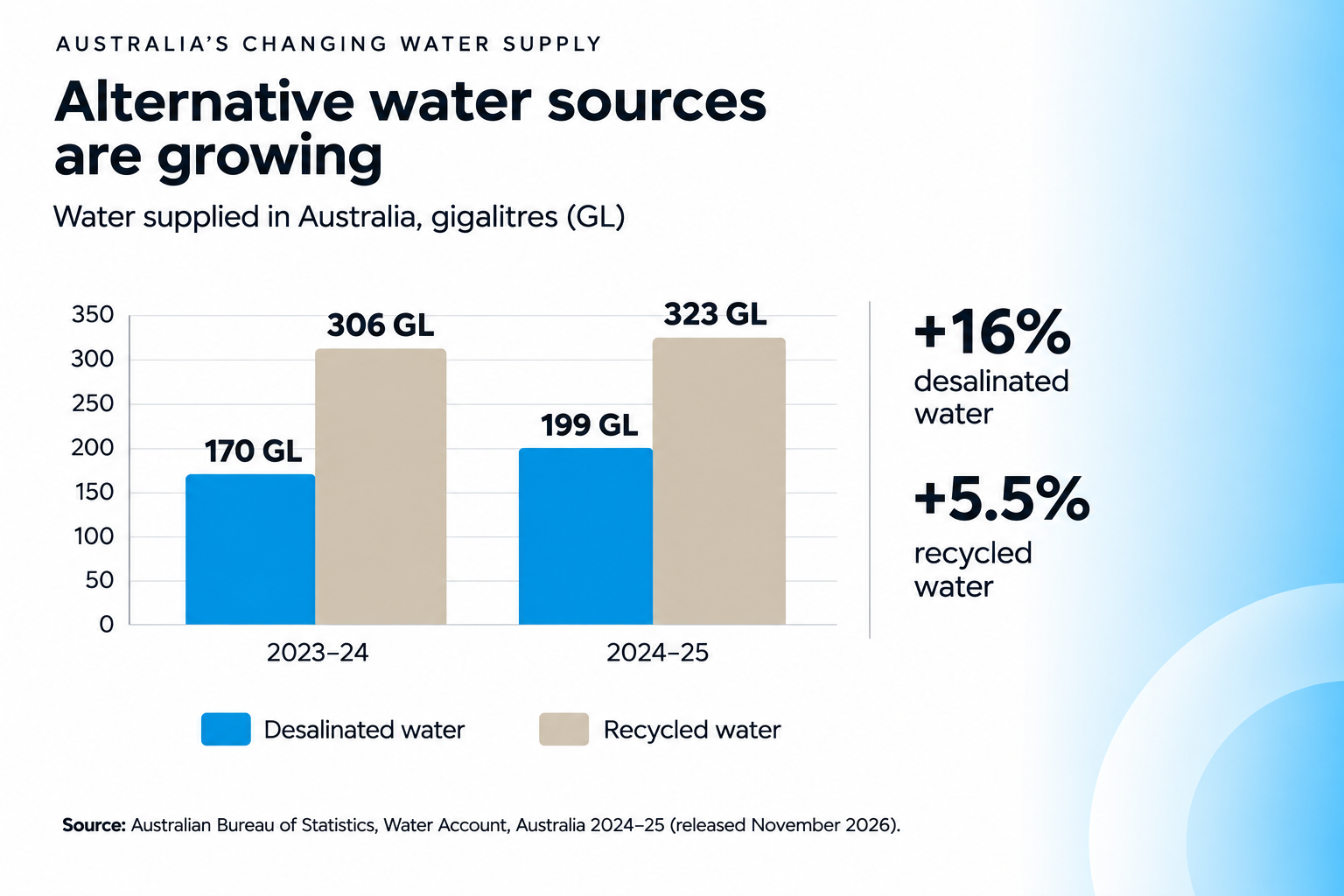
These volumes remain a small share of national consumption, but they are strategically important, particularly in regions exposed to long dry periods.
The aim is not to replace conventional sources. It is to create a balanced mix that improves reliability while taking account of energy use, environmental effects and long-term operating costs.
Water reuse: turning wastewater into a strategic resource
Australia’s experience also shows the growing value of treated wastewater as a resource.
Reuse can ease demand for conventional freshwater and provide water for irrigation, industry, urban services and, where appropriate, drinking water systems.
Perth’s Groundwater Replenishment Scheme shows how advanced treatment can strengthen water security.
The scheme purifies wastewater to drinking water standards before recharging deep aquifers. The water is stored underground and can later contribute to the city’s supply.
The scheme began operating in 2017. Its expansion doubled advanced treatment capacity from 14 billion to 28 billion litres a year.
Beyond the technology, the project marks a change in how utilities treat wastewater. Rather than seeing it only as a residual stream for disposal, they can include it in the available supply mix.
This matters most where freshwater is scarce and alternative supplies can ease pressure on rivers, reservoirs and aquifers.
Managing demand alongside supply
Infrastructure alone cannot secure water over the long term. Australia’s experience also shows the need to manage consumption.
During droughts, Australian cities introduced restrictions, conservation campaigns and efficiency programmes to cut household and commercial demand.
According to the ABS, average household water use in 2024–25 remained 7.7% below its 2015–16 level, despite a recent rise linked partly to warmer and drier conditions.
Demand management extends beyond households. Utilities can preserve existing resources by cutting leaks, improving network efficiency and monitoring use. Industrial users can optimise processes, recycle more water internally and reduce freshwater withdrawals.
The principle is simple: water security requires both reliable supply and better use of the water already available.
From cities to industry: planning for water resilience
The lessons from Australia’s cities apply increasingly to industrial development.
Mining, manufacturing, energy and other industries need reliable water, often in places where freshwater is scarce or seasonal.
In Australia, mining used 809 GL of water in 2024–25, 8.2% more than in the previous year. Manufacturing use also rose, reaching 401 GL.
These figures show why water must form part of industrial planning and investment decisions.
For an industrial facility, water availability can shape site selection, technology, operating costs and long-term production. This is especially important for mines in remote or arid areas, where conventional freshwater may be scarce or hard to reach.
Desalination, wastewater reuse, recycling and dedicated water infrastructure can reduce an industrial operator’s exposure to scarcity.
The right strategy depends on a full view of the operation’s water cycle, from sourcing and treatment to use, recovery and discharge.
Water should therefore be considered from the start of a project, not treated as a separate operating need once the facility has been designed.
Almar Australia: a regional platform for Asia-Pacific
Australia faces many of the same water pressures as the wider Asia-Pacific region. Industrial demand is rising, climate patterns are becoming less stable and freshwater resources face greater strain.
Through Almar Australia, its regional platform for Australia and other Asia-Pacific markets, Almar Water Solutions brings international experience in developing, investing in and operating water infrastructure, combined with a regional approach to municipal and industrial needs.
This presence advances the company’s strategy of developing integrated water solutions suited to local conditions, with a focus on long-term security, efficient use of resources and sustainable industrial development.
The Australian lesson: planning for uncertainty
Australia does not offer a universal model. Its geography, institutions and water resources differ from those of other countries. Climate variability, environmental pressure and competing demand also remain difficult challenges.
It does, however, show the value of moving from short-term responses to long-term resilience.
For countries and industries facing greater water stress, the main lesson is not to rely on one source or technology. They need flexible systems that combine infrastructure, a diverse supply mix, reuse, efficiency and long-term planning.
The future of water security will depend not only on how much water we can produce, but on how well we manage the resources already available.